What is a VA IRRRL?
A VA IRRRL (Interest Rate Reduction Refinance Loan), often called a VA streamline refinance, lets eligible borrowers refinance an existing VA loan into a new VA loan—usually to lower the interest rate or payment. Compared with a full refinance, an IRRRL often involves less paperwork and a lower funding fee. Many files do not require a new appraisal, but lenders may still order one based on overlays, loan size, or points.
Plain English: You already have a VA loan, and an IRRRL is a simpler way to refinance it—usually to reduce your rate or payment—without taking cash out.

Why do a VA IRRRL?
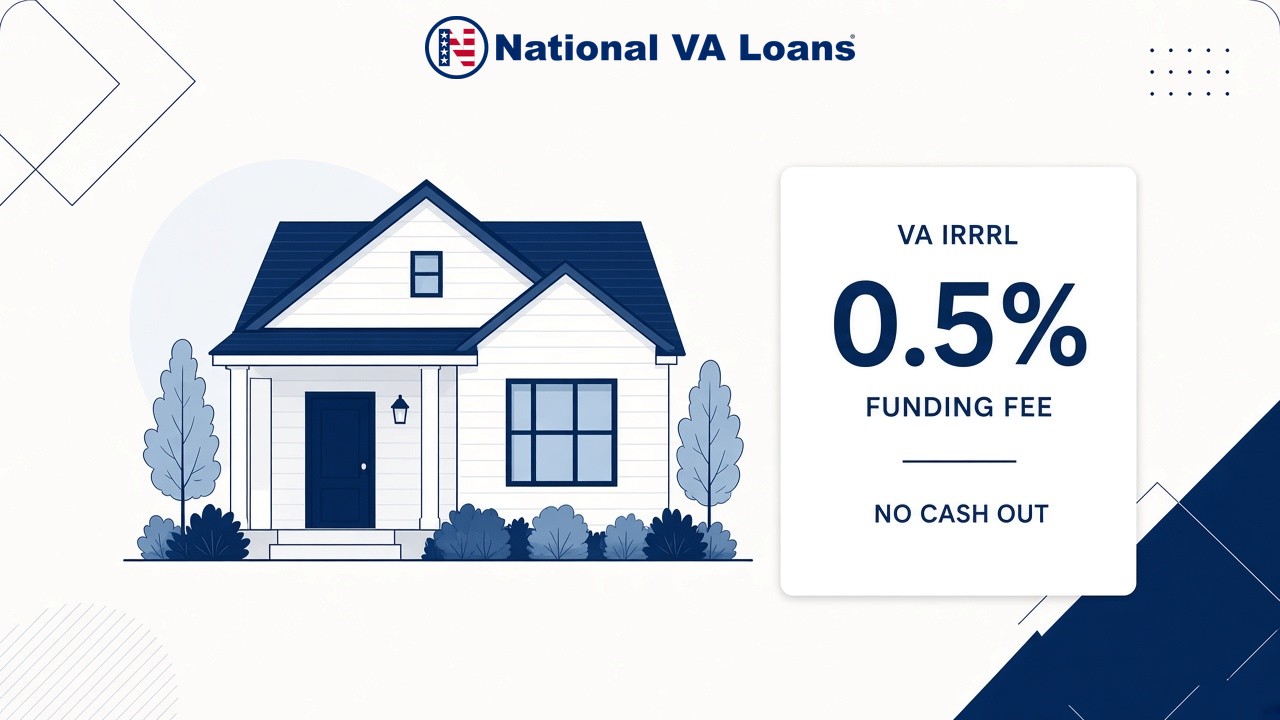
A streamline is built for the VA loan you already have. The close is shorter, the file is lighter, and the funding fee is 0.5%.
Quicker. A clean file is a shorter refinance.
At National VA Loans, a streamline is a shorter file than a purchase or a cash-out. VA already guaranteed the loan on the house. Title work, a second lien, or a seasoning date that has not arrived yet is what stretches the close.
Easier. Less of the file has to be built from scratch.
Most IRRRLs skip a new appraisal, and income paperwork is often lighter than a purchase. We review the Certificate of Eligibility when the file needs it. A lender can still ask for credit, income, or an appraisal.
Cheaper. The funding fee is 0.5%, and it can be financed.
On a $300,000 loan that is about $1,500. Exempt veterans pay nothing. Closing costs are still real. You can roll them into the loan or offset them with a lender credit. The new loan does not add monthly mortgage insurance.
- Pay it off sooner. You can choose a shorter term and retire the loan faster. The new term generally cannot run longer than the years left plus 10, and it cannot pass 30 years. A longer term can cut the payment and raise the interest you pay.
- Energy work stays with the house. Up to $6,000 of allowable energy-efficiency improvements can be added to the loan. The money pays for that work.
- The rate still has to earn it. Fixed to fixed, the new rate generally has to drop at least half a point. Leaving a VA adjustable-rate loan for a fixed payment can still be the reason, even when that fixed rate is a little higher, because the payment stops resetting.
When should you use a VA streamline?
You already have a VA loan
A streamline refinance only replaces a VA mortgage. A conventional or FHA loan needs a different path, usually a VA cash-out.
The rate drop is real
On a fixed-to-fixed refinance, the new note rate generally has to be at least 0.50 points lower than the loan you have now.
You want off an ARM
Moving a VA adjustable-rate loan to a fixed payment can be the whole point, even when the new fixed rate is a little higher.
You do not need cash
The new loan pays off the VA mortgage and the refinance costs. It is not a way to pull equity out or consolidate other debt.
You may have moved
You certify that you lived in the home before. A house you kept after a PCS, and now rent out, can still qualify.
You want a lighter file
VA does not require a new appraisal on most IRRRLs, and income paperwork is often lighter. A lender can still ask for either.
The three tests every IRRRL has to pass
Seasoning: 210 days
The new loan cannot close until 210 days have passed since the first payment was due on the current VA loan, and you have made at least six monthly payments. The later of those two dates controls.
Rate drop: 0.50 pt
Fixed to fixed, the new rate generally has to be at least half a point lower. Moving from a fixed rate into an ARM usually takes a larger drop, often two points. An ARM into a fixed rate can go up, because the benefit is a payment that will not reset.
Recoupment: 36 months
Allowable closing costs generally have to be earned back within 36 months of principal-and-interest savings. If the savings do not cover the costs in that window, the refinance fails the test.
Read official VA IRRRL guidance
Limits that change the payment
VA IRRRL loan term limits
The new term generally cannot run longer than the years left on the current VA loan plus 10 years, and it cannot pass 30 years. A shorter term is allowed. Stretching the term can lower the monthly payment and raise the interest you pay. Shortening it does the opposite.
Why a 15-year term can raise the payment
A 15-year term pays the balance off faster, so the monthly amount can rise even when the rate is lower. A shorter term can raise your payment even when the rate drops; use the calculator with your own numbers.
Lender credit overlays
A lender credit pays some closing costs in exchange for a higher rate than you would get without the credit. On a fixed-to-fixed IRRRL, that rate still generally has to be at least half a point below the loan you have now, so the credit cannot eat the whole rate drop. The credit has to go to allowable costs. If it is larger than those costs, the extra can look like cash back, and an IRRRL does not allow that. A lender can also cap the credit, or decline one that would fail the rate test or the 36-month recoupment test. Ask for the rate with the credit and without it.
VA IRRRL Maximum Loan Amount & Form 26-8923 Worksheet
VA does not set a maximum dollar amount for an IRRRL. Instead, the new loan is capped by what it pays off and what it costs. Lenders must calculate the limit on VA Form 26-8923, the Interest Rate Reduction Refinancing Loan Worksheet, and submit a signed copy with every IRRRL.
- Existing VA loan payoff. Including accrued interest and fees through the payoff date
- + Energy-efficiency improvements. Up to $6,000
- + Allowable fees and closing costs. Origination fee, title, recording, prepaids
- + Discount points. No more than two points can be financed
- + VA funding fee. 0.5%, unless you are exempt
This mirrors the line math on VA Form 26-8923. Move a slider or type a number from your payoff statement and Loan Estimate to see roughly how large the new loan can be.
View VA Form 26-8923 (official PDF)
VA streamline questions
What is a VA streamline refinance?
It is the VA Interest Rate Reduction Refinance Loan, or IRRRL. It replaces the VA mortgage you already have with a new VA loan, usually to cut the rate or to trade an adjustable rate for a fixed payment. Veterans often call it a VA streamline because the file is shorter than a full refinance.
When should I refinance with an IRRRL?
When you already have a VA loan, the new rate clears the half-point test or you are leaving an ARM, you do not need cash, and the monthly savings cover the costs inside 36 months. If you need equity, or the current loan is conventional or FHA, look at a VA cash-out instead.
How long does a VA IRRRL take?
A clean file at National VA Loans is a shorter refinance than a purchase or a cash-out. Title, a second lien, or a seasoning date that is still in the future are the usual reasons a file takes longer.
What do I need to qualify?
An existing VA loan, the 210-day and six-payment seasoning clocks, a net tangible benefit, and a certification that you previously lived in the home. You generally need to be current. VA does not set a credit-score minimum, but a lender can still review credit or ask for income.
Are there closing costs on a VA IRRRL?
Yes. Title, recording, the 0.5% funding fee, and any lender fees are real costs. You can roll them into the loan or offset them with a lender credit. “No closing cost” means you are not writing a check at the table. It does not mean the refinance is free.
Can I get cash back at closing?
No. An IRRRL pays off your VA loan and the allowable costs. It is not a cash-out loan, and it does not consolidate credit cards. Small refunds can happen, but amounts over about $500 draw extra VA review.
What is the VA funding fee on an IRRRL?
Typically 0.5% of the loan amount, whether this is your first VA loan or a later one. On $300,000 that is about $1,500. Veterans with a qualifying disability exemption pay $0. The fee can be financed.
What is the VA IRRRL max loan amount?
VA does not publish a dollar cap. The maximum is the payoff of your current VA loan, plus allowable closing costs, no more than two financed discount points, up to $6,000 of energy improvements, and the funding fee. The result is rounded down so you do not receive cash. The calculator on this page follows that VA Form 26-8923 math.
What is VA Form 26-8923?
It is the Interest Rate Reduction Refinancing Loan Worksheet. Your lender uses it to compute the maximum loan, then sends a signed copy to VA with the file. You do not complete it yourself. Ask for a copy if you want to see the lines.
Do I need an appraisal?
Usually no. VA does not require a new appraisal on most IRRRLs. A lender may still order one because of an overlay, the loan size, or financed discount points. Ask before you start if your file is likely to need one.
Can the new rate be higher?
On a fixed-to-fixed IRRRL, no. The rate generally has to fall by at least half a point. The exception is an adjustable-rate VA loan moving to a fixed rate, where a higher fixed rate can still be a benefit because the payment stops resetting.
Can I streamline a home I no longer live in?
Often yes. You certify prior occupancy, not that you live there today. A former home you rent after a move can still be eligible. Lender rules still apply.
Do I skip a mortgage payment?
Not in the way ads imply. Interest is collected through closing, so there can be a month with no payment due, and the old servicer usually refunds the escrow. Interest on the new loan still accrues every day. Treat any gap as timing, not free money.
What are the VA IRRRL loan term limits?
The new term generally cannot run longer than the years left on your current VA loan plus 10 years, and it cannot pass 30 years. A shorter term is allowed. A longer term can cut the payment and raise total interest. A shorter term can raise the payment because the balance is paid off faster.
Can a 15-year VA streamline raise my payment?
Yes. Shortening the term pays the loan off faster, so the monthly principal and interest can rise even when the rate drops. A shorter term can raise your payment even when the rate drops; use the calculator with your own numbers.
How does a lender credit work on a VA IRRRL?
A lender credit covers some closing costs in exchange for a higher rate. On a fixed-to-fixed IRRRL the rate still generally has to drop at least half a point, so the credit cannot use up that whole drop. The credit has to pay allowable costs. A credit larger than those costs can look like cash back, which an IRRRL does not allow. Lenders can add their own cap, or say no when the credit would fail the rate test or the 36-month recoupment test.
Is a VA IRRRL worth it?
It is worth a look when the monthly savings cover the costs inside 36 months and you expect to keep the loan past that break-even. It is a weak fit when you need cash, you will sell soon, or restarting the term wipes out the savings. Run your numbers in the calculator before you request pre-qualification.
IRRRL calculators on this page provide educational estimates only. They are not a rate lock, Loan Estimate, or loan approval. Seasoning, net tangible benefit, funding fee, appraisal, credit, and income requirements depend on VA rules and lender overlays. National VA Loans is powered by Stride Bank, N.A., NMLS #466690, and is not affiliated with the Department of Veterans Affairs. Pre-qualification is not a commitment to lend.